
As we are advancing in technological terms in 2026, mobile app usage will increase by 90%. To succeed in the digital journey, one must go through the App development cost at first. If we talk about UK, the market is mostly demanded by FinTech, HealthTech, and eCommerce solutions. Currently, the UK app development cost 2026 is influenced by the Integration of AI, advanced cybersecurity, and cross platform efficiencies.
For the basic applications with basic features the pricing may start from £5,000 – £10,000. It rises according to the features you are including in the app development cost. Breaking down the budget cost , approximately 70% of the budget is allocated to coding and QA and the rest 30% includes project management, design, and initial payment. Apart from that, the cost requires the hourly rate of senior developers if you are hiring a freelancer or agency or large scale firm.
To keep the app compatible with iOS and Android versions, the stakeholder must account for 15-20% of annual maintenance fee. As the UK mobile app market revenue is expected to grow at CAGR by 8% , it has become mandatory to invest in robust, scalable architecture. If one plans strategically, they can reduce waste by 25%, in order to get high ROI in this competitive digital economy.
Factors Affecting App Development Cost in UK
To get an estimate of the app development cost in UK, we need to know what are the factors that affect the app development cost. The basic ones start at a lower cost but the commercial viable products may cost higher. Let’s understand what are the factors affecting the cost of the app development.
Complexity and Feature Set:
It is the first cost driver. If you choose basic apps with basic UI design and basic features like email login, then it will be more affordable but if you use advanced features like AI-driven personalization, GPS tracking, or some other complex API integrations because it increases the development hours and the efforts.
Platform Selection:
Another app development cost decider is the platform choice, whether you are choosing Native or cross platform development. If you are choosing cross-platform , you can reduce the cost by 30%. Native apps are mainly used for superior performance and for high intensity markets like HealthTech or FinTech solutions.
UI/UX design:
A standard interface design represents a major disadvantage for companies that operate in the highly competitive UK marketplace. The process of developing custom animations together with user-friendly navigation systems and detailed interactive models will lead to increased user retention rates but needs experienced senior designers who will increase the overall development expenses for UK applications in 2026.
Backend Infrastructure & Security:
Organizations need to establish strong encryption methods together with secure database systems because they face increasing threats from advanced cyber attacks. It increases the project budget as developing a backend system that supports thousands of users needs security and system capacity expansion.
Development Team Location & Expertise:
If you are hiring the development team from the UK, it will cost you higher due to the location preference. The developers in the UK will charge a higher hourly rate as they possess specal;ized training in Machine learning and blockchain. But there is an alternative to the same, you can hire developers from North India where the cost of developing is less and the work quality is better.
Apart from these factors, even post-launch requirements are there to count. QA is not a matter of one time event, it goes under various tests across different devices and OS versions in order to remove the bug system. While you are planning to develop an app in the UK, you should keep a contingency fund to maintain app relevancy even in the fast-paced digital economy.
MVP vs Full-Scale App: Choosing the Right Approach for Your Business
When planning to build a mobile application in the market, the main app development cost lies in choosing a Minimum Viable Product [MVP] and a full scale application. This choice decides the fate of your time-to-market, risk mitigation, and eventual ROI. Let’s have some insights on which one is important and have better features.
MVP: An MVP is the foundation of your app, that has the core features to resolve basic user problems and authenticate your market hypothesis. It is mainly for rapid deployment, where it collects real user feedback.
Key Advantages of the MVP Approach:
Lower Initial Investment: If you focus only on the core or essential features, it will reduce the development time and hence the cost. With that it is more feasible for the startups.
Faster time-to-market: The time taken to launch the MVP is just half of the full scale product. It is helpful in providing a competitive edge in this digital 2026 era.
Reduced risk: Without taking the risk of inputting a massive budget in a complex product that has the probability to fail, MVP is better in developing just the core features first. It reduces the actual budget of coding and QA by 70%.
Full Scale App: A full scale app is a full featured product with advanced UI/UX, strong backend infrastructure from the beginning. Due to the advanced features it possesses, it has higher initial investment and increased risk.
Considerations for a Full-Scale App:
High developmental cost: It contains a complex feature set, with elements like AI-driven personalization, GPS tracking, advanced API. It increases advanced development time and in turn the cost, especially when you rely on UK developers.
Intensive UI/UX requirements: Intense UI/UX designs includes custom animations, detailed interactive models, user-friendly navigation system. This set of development needs experienced senior writers, who charge more than the usual price.
Scalability Requirements: In full scale development, a backend system and security infrastructure is implemented. It is implemented to support thousands of users that need higher investment in secured database systems and encryption methods.
If you are just entering the UK market, then you must go for MVP development , but if you are already a grown up business, then go for advanced features like full scale apps development that has advanced features but is higher in cost.
| Features | MVP Approach | Full scale approach |
| Pricing | MVP is done with low cost as it includes core features. | Full scale approach is higher in cost due to advanced features. |
| Risk | It is better for startups or someone with a low budget as it does not demand a high amount to be spent all at once. | It has higher risk as the cost invested is higher and if the business leads to failure, all the amount invested is just a waste. |
| UI/UX designs | It includes the basic UI/UX design as a part of core features. | It includes an advanced UI/UX design with custom animations, detailed interactive models, and a user-friendly navigation system. |
| Time taken | MVP requires less time as it only includes core features. | It requires more time due to advanced levels of development. |
iOS vs Android App Development Costs: What Businesses Should Know
Both the platforms have immense reach and the technical requirement and the testing protocols for both iOS and Android app development is different, it clearly affects your App development cost. To determine the app developmental cost in 2026, one must know about the iOS and Android app development.
Earlier, the iOS development was faster and but now Apple has launched its diverse hardware with various screen sizes, chipsets, et, and this has led to its slower processing.
On the other hand, Android apps are responsible for fragmentation, due to its huge manufacturers and operating system versions. It enhances the QA cycles that can enhance the App development cost, if not monitored via automated testing frameworks.
The UK app development cost 2026 is highly dependent on your choice of native or cross platform approach. Native platforms need a separate codebase for each platform, which doubles the coding effort. But cross platform reduces the app development cost by 30% without compromising on the quality.
Key technical considerations for platform selection include:
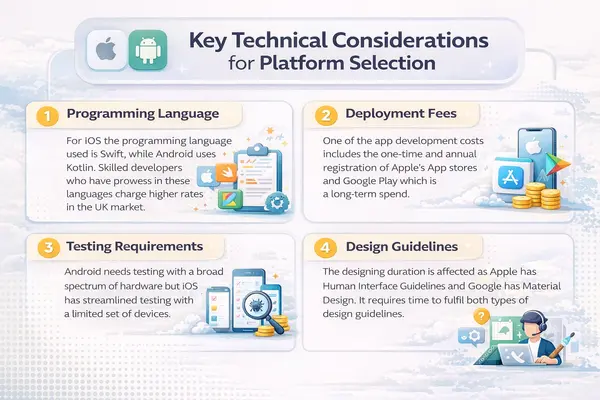
Programming Language: For iOS the programming language used is Swift, while Android uses Kotlin. Skilled developers who have prowess in these languages charge higher rates in the UK market.
Deployment Fees: One of the app development costs includes the one-time and annual registration of Apple’s App stores and Google Play which is a long-term spend.
Testing requirements: Android needs testing with a broad spectrum of hardware but iOS has streamlined testing with a limited set of devices.
Design Guidelines: The designing duration is affected as Apple has Human Interface Guidelines and Google has Material Design. It requires time to fulfil both types of design guidelines.
Ultimately your choice must be driven by user data. If your target audience is more Apple users, then you must prioritize iOS for faster ROI. For a better wide market reach, a cross-platform strategy would work better with a cost-effective path forward.
Hidden Costs of App Development Most UK Startups Overlook
Whenever we are calculating the App development cost, we often see the core development hours or the UI/UX design, but we often overlook some of the essential but hidden costs of app development throughout the app launch cycle and even the post launch cycle.
If you overlook them, it will lead you to overrunning the budget, with hampered market entry, and compromised final product. These overlooked expenses will hype up 30-50% of the initial quote to your preplanned budget.
Let’s have a glance at what are some of the hidden app development cost most UK startups overlooks:
Post-Launch Maintenance and Updates:
The app development cost doesn’t end with its launch. There is post-launch maintenance to keep the products functional, secure, and relevant. It also contains bug fixing, updating new iOS and Android versions, and introducing new features as per the requirements. If you neglect maintenance, it can lead to performance degradation and safety vulnerabilities. At least 15-20% of the annual budget must be kept for post launch maintenance.
Third Party API & License Fees:
Many advanced features use proprietary APIs such as payment gateways like PayPal, Stripe, mapping systems like Google Maps, or special authentication services. These services have in-app purchases. Some of them demand annual subscriptions like security features, data storage solutions, and professional development tools. These are commercial applications and demand a certain amount to be spent on. So, consider it in the countable expense and not the hidden ones.
Compliance and Legal Fees:
If you are planning mobile app development, UK, then you must know about GDPR. It is a process in which the UK government governs on how organizations use personal data to ensure privacy, safety, and transparency. It is done with special legal consultations, adding more time and complexity to the development process. If any organization fails to pass the legal checks and security audits, resulting in massive fines.
Marketing and User Acquisition:
Building the product is 50% of the battle, submitting it to the users is another. Many startups underestimate the cost of marketing and user acquisition. If you want to achieve visibility, then you must focus on App Store Optimization [ASO], paid advertising, user acquisition tips, and strategic content marketing. It is vital for the zenith of any mobile app development UK project.
Scaling and Infrastructure Upgrades:
With the increment in the user base, a significant increase in backend infrastructure is also required as the infrastructure designed for small loads will collapse. Here enters the inevitable cost to expand the infrastructure as per the user base expansion- Database capacity, server performance, enterprise-level cloud services like AWS or Google Cloud. They are sudden and unplanned but necessary, if you won’t count it in your ‘cost to develop app in UK’ list, then your budget can go short for money.
In-House vs Agency vs Hybrid Teams: Which is More Cost-Effective?
Choosing the perfect team structure is crucial as it has a direct impact on the total App development cost. Every model has its own advantages and drawbacks in terms of expertise, control, financial commitment, etc. To know which one suits you the ebay, you need to dive deep into both of their pros and cons to select the perfect team for your mobile app development in the UK.
In-house teams: In this model, you hire a full development team for your app building in the UK. It includes all the team members in-house. It is preferred when you need alignment with the company culture. But it is more expensive than others as it includes extra costs apart from app development like salaries, bills, assets, working space rent, etc. If you have consistent multi-year developmental needs, you can go for this model, else it is very costly.
Specialized Agencies: Agencies provide experienced employees to start immediately. Although the hourly rates are higher than individual salaries, you only pay for what services you have acquired. It reduces long-term liabilities and training costs. Agencies are better in increasing Return of Investment by reducing time-to-market.
Hybrid Models: In this approach a basic in-house team is required and is a renowned model of 2026. This model, a balanced cost structure is maintained where the burden of massive permanent payroll is released. In this model, according to the current requirements, scaling up or down the development workforce is maintained.
In the end, the affordable choice depends on your project’s scale. Agencies are good for defined projects whereas hybrid teams offer flexible growing business to handle their budget without compromising quality.
Cost Optimization Strategies to Build an App in UK
As the app development costs are higher in the UK, the major concern for startups and renowned businesses is to reduce the cost in every possible way. If you plan strategically, you can succeed in lowering the cost without compromising the quality. Let’s discuss some cost optimization strategies to build an app in UK:
Minimum Viable Product: Use a minimum viable product approach so that paying for only the core features will be much more affordable than diving deep into the advanced features. It saves time and money when resources are allocated to only the validated components, reducing the unnecessary ones.
Platform selection: Native vs. Cross-platform: If you are choosing to develop the native apps separately like iOS and Android differently, then the cost will rise automatically. But if you choose to build a single cross-platform app development, then you can cut the cost accordingly.
Team Structure: Your cost is decided by the team structure, you are choosing. If you are choosing a UK-based in-house team, it will cost you higher than hourly rates, if you are outsourcing any hybrid model team, then it will be comparatively lesser with flexibility and cost savings. It allows businesses to have advanced AI integration or blockchain proficiency while lessening the burden of massive permanent payroll.
Post Launch Maintenance: If you are doing this mistake of not counting the post-launch maintenance costs, then stop it right now! Because the app development cost doesn’t end at the mobile app launching, it requires continuous efforts, bug removal, and more such post-launch paid support. Start saving for them earlier than ever to avoid any loss.
Maximizing ROI Through Professional App Development
If you want to invest in a professional mobile solution, it requires a clear understanding of the App development cost to enhance the profitability. Just creating a product isn’t enough in this competitive market, you need to maintain the modern complexities to maximize your ROI.
The UK app development cost assessment process requires developers to select their most effective features which will enhance user interaction with their application. Professional teams assist businesses in choosing their technical stack for either MVP development or full deployment according to which option provides superior system efficiency with lower operational costs. Cross-platform frameworks enable businesses to cut their development costs while delivering identical high-quality results for both iOS and Android devices which maximizes their product reach to customers who make purchasing decisions.
Companies need to implement complete build management which includes both building and marketing activities to achieve their maximum return on investment. An app that achieves optimal performance through its design will enable users to remain engaged with its features while decreasing the expenses required to obtain new customers. Businesses can establish data-driven product improvements which increase value through their use of advanced analytics and feedback loops from the beginning of their operations. The complete financial investment generates a digital asset that drives sustainable growth within the fast-changing UK technology market.
How to Choose a Reliable App Development Company in UK
Here are some of the methods to check-upon to choose a reliable app development company in the UK.
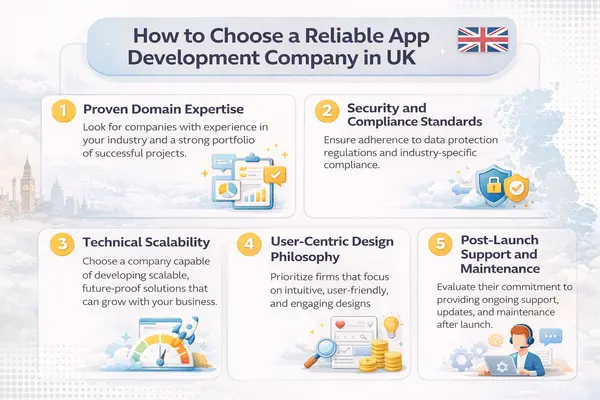
- Proven Domain Expertise: Always shortlist the company with a documented portfolio in ridesharing app development. They must have deep knowledge of multiple point route analysis, real-time GPS tracking, and logistical obstacles associated with mobile app.
- Security and Compliance Standards: Safety must be their topmost priority. The right partner will always offer high security features like multi-factor authentication, government ID verification, complete GDPR compliance to safeguard data.
- Technical Scalability: The company must be technically stable so that they can handle an increasing user base without performance degradation. Test them if they can successfully build scalable cloud architectures to monitor thousands of concurrent requests and matching complex algorithms in milliseconds.
- User-Centric Design Philosophy: A successful app needs an intuitive interface for users. Also, their UL/UX testing must be very effective to lessen friction while booking and ensuring high user retention rates.
- Post-Launch Support and Maintenance: The world is expanding digitally faster than ever. So, go for such mobile app development companies that offer post-launch support that contain regular security, updated features, and monitoring performance to keep your app in top lists.
If you want affordable plus quality mobile app development in the UK, then go for Esferasoft solutions. They also offer customization for you to pay only for the services you are using as per your budget.
Step-by-Step Process to Build a Robust Mobile App in UK
A successful mobile app in the UK needs a strategic approach, rigorous testing and post launch support. If you will understand the entire pipeline, you will understand the overall management of App development cost and high ROI. This strong process is made to mitigate risks, compliance with UK standards like GDPR, user-centric products to reach the market’s high expectations. Let us dive into the step-by-step process to build a strong mobile app in the UK.
Discovery and Strategy: The first step is the market research and defining the unique value proposition. It also involves creating a feature roadmap, starting with MVP. It reaches a peak in creating wireframes and a technical documentation to outline the scope and lessen unpredicted costs later.
UI/UX Design: Then next comes the creation of intuitive, appealing, tempting, and compliant user experience. It involves conversion of wireframes into High-Fidelity mockups, ensuring partnering with both Apple’s Human Interface Guidelines and Google’s Material design.
Development and Quality Assurance (QA): Developers add their main coding work at the iterative developmental cycle as in when they are developing both front-end and back-end system elements. After this initial development stage testing, teams begin their testing process which they conduct across different devices and operating systems to find and fix software defects. The UK app development process requires effective QA because it helps identify technical debt problems which lead to high development expenses that extend throughout the project.
Deployment and Launch: Before launch, you need to comply completely with the guidelines of Apple App Store and Google Play Store to pass the detailed security examinations.
The current phase includes construction of final system components which will support future growth together with development of the ASO and marketing strategy to execute the product launch.
Post-Launch Maintenance and Iteration: An app’s life cycle continues indefinitely after launch. The process includes ongoing performance tracking together with user feedback collection and software defect resolution and new software feature implementation which represents a major yearly cost for the organization.
This organized development process from initial idea development through post-release assistance establishes the necessary framework needed to develop an effective mobile application which will succeed in the UK market.
Conclusion
People who want to navigate the digital landscape in Great Britain must understand which factors determine the total expenses needed to develop applications. The market analysis shows that three factors, which include development complexity and platform selection and specialized UI/UX design, represent the main expenses for development work. The UK app development cost 2026 shows businesses need to implement artificial intelligence systems and strong cybersecurity protection to meet current industry requirements.
The organization needs to dedicate its resources according to its choice between developing a low-cost MVP solution or launching its complete product to achieve effective marketing results. The organization needs to identify all expenses which include GDPR compliance costs and digital asset maintenance expenses that will protect their online resources throughout their entire lifecycle.
The UK app development cost 2026 serves as a financial commitment towards building scalable frameworks which create user-friendly systems that support continuous business development. UK startups can attain high returns on investment through partnership with skilled technical professionals and implementation of strategies that reduce expenses in the constantly changing technology industry.
Frequently Asked Questions ( FAQ’S )
How much does it cost to build a mobile app in the UK?
To build an app in the UK, the basic package with basic features starts from £5,000 – £10,000., rest it depends on what other features are you adding on.
What factors affect the cost of app development in the UK?
There are numerous factors that determine the cost of app development in the UK such as, team type and size, location of the team, backend infrastructure, complexity, platform selection, and UI/UX design.
Is it better to start with an MVP or a full-scale app?
If you are a startup, then without taking a risk, start with MVP that has core features development. But if you are already a growing business, then go for full-scale app development which has all the advanced features but is more expensive than MVP.
How much does it cost to build an MVP in the UK?
To build an MVP in the UK, the cost is unpredictable as such, but it depends on how many features you are adding in.
Do iOS apps cost more than Android apps in the UK?
Yes, iOS apps cost higher than android due to strict security guidelines and quality standards.
What are the hidden costs in UK app development?
Hidden costs in the UK app development are- Third-party API licenses and fees, post launch maintenance, compliance and legal fees, Marketing and User Acquisition, and Scaling and Infrastructure Upgrades.
Can I reduce app development costs in the UK?
Yes, you can reduce the app development cost by choosing MVP development, cross-platform development, hybrid team model, and early preparation of post launch maintenance.
Which features add the most cost to a mobile app in the UK?
The features that cost most to a mobile app in the UK are the advanced features like integration of AI, security payment gateways, complex data and backend, and advanced user experience.
What is the typical maintenance cost after app launch in the UK?
The typical maintenance cost rises up to 30% of the original app development cost.
How do third-party integrations affect app development costs?
With third-party integrations, app development costs rise due to app complexity, specialized expertise, and mandatory testing.