
The next billion-dollar platform won’t be a single-purpose app. It will be a super-app. WeChat has more than 1.4 billion monthly active users, and 935 million of them have made successful payments using WeChat Pay. India’s UPI rails, on the other hand, processed 229 billion transactions in 2025. Payment apps like Google Pay, Paytm, and PhonePe are all vying for the super app position right at the top.
However, the race for a super app development is no longer regional; it’s become global and is successfully accelerating the way startups, enterprises, and governments must think about the digital product strategy.
If you are also planning for the same, but don’t know where to start, this comprehensive guide is for you and all the trailblazers and decision-makers, like CEO, CTO’s, and investors. By the end, you’ll get to know what a super app actually is, the seven business benefits that justify the investment, the must-have features, the architectural decisions that make or break the build, the ten-step roadmap to launch, real cost expectations, and where the market is heading next.
What Does Exactly Super App Development Mean?
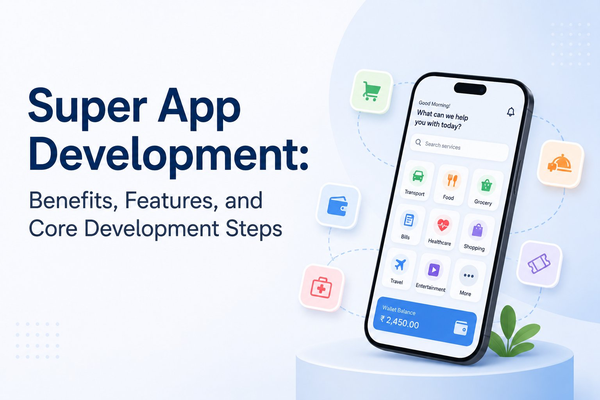
Typically, a “Super App” is an open-source single mobile platform that stitches multiple high-frequency services, including payments, messaging, ride-hailing, food delivery, e-commerce, and government access. Moreover, the user logs in once, pays once, and never has to leave the app to switch between services.
How Super Apps Differ From Multi-Service Apps
There’s one real distinction that sort of matters most: super apps let mini programs run inside them, and those mini programs can be made by third-party developers, not just by adding more features from the same host company. That one architectural idea, and it’s the thing, is what takes a multi-service app and turns it into a whole ecosystem.
The Three Pillars That Define a Super App
Every legit super app sits on three pillars. First, unified identity, meaning one login, one profile, one wallet. Second, embedded payments, so the money never really leaves the platform. Third, a mini app marketplace, so third-party developers can plug in. Miss even one of those pieces and then, what you end up with is more like a multi-service app, not a true super app.
The Global Super App Landscape: Who Dominates and Why
The global dominance of an all-in-one app development landscape is bifurcated into three different categories:
Asia Pacific (The real Birthplace of Super Apps)
WeChat truly dominates messaging, payments, and mini-program services in China with an exceptional MAU of 1.3 billion+. Alipay started as a sort of payment thing for Taobao, and then it sort of morphed into a bigger commerce ecosystem. Grab began with ride hailing, then expanded into a 20+ service platform across Southeast Asia, kind of like you know. Gojek did a similar move in Indonesia, from motorcycle taxis into healthcare plus logistics too. Paytm and PhonePe in India are also pushing hard to build super apps right on top of UPI.
The Middle East and Africa Surge
Careem, which was acquired by Uber for $3.1 billion, now dominates ride-hailing, payments, and food delivery across MENA. Yassir is the fastest-growing super app in North Africa. M-Pesa basically rewired Kenya’s economy, starting with mobile payments and then going further. You also have government-style super apps like UAE Pass, Tawakkalna, and Absher, showing how civic services can get bundled into one citizen-facing platform.
Western Markets Catching Up
Western markets took longer to fully adopt the super app idea, mainly because privacy rules are stricter and consumer behavior is more fragmented, not as neat. Even so, Revolut, Klarna, and Cash App are building fintech-first super apps that fit around GDPR. X is openly chasing the WeChat style. And Microsoft Teams has turned into an enterprise super app for collaboration, even if people still don’t call it that.
Super apps already serve more than 3.5 billion users across Asia alone in 2026—almost half the planet, using just one category of product.
The Four Main Types of Super Apps
- Consumer Lifestyle (Grab, Gojek, and WeChat)
These apps are best-suited for messaging, transport, food, payments, and entertainment all under one roof. These are ideal for capturing the daily use behavior and expanding outward.
- Fintech First (Alipay, Paytm, and Apple Pay)
Start with a digital wallet and expand into commerce, lending, insurance, and lifestyle services. It’s just like an entry point that opens the door to everything.
- Enterprise Apps (Microsoft Teams, Salesforce, and Slack)
Such apps are made to smooth the internal business workflows, chat collaboration, task management, CRM, and ERP all into one interface.
- Government and Civic (UAE Pass, India Stack-powered apps)
Government apps sort of pull together citizen services, like ID verification, tax filing, healthcare access, and permits, into one unified, government-issued platform—so it feels more like a single channel than a bunch of separate portals.
Key Benefits of Super App Development for Businesses
The super app development brings a series of benefits for all-scale businesses and is discussed in detail below:
- Higher User Retention & Engagement
When a user already has their identity, payment method, and even their payment history sitting in one app, then the switching cost becomes really high. Hence, WeChat users tend to open the app 15+ times daily, and to be honest, it is hard to mimic the same rhythm with single-purpose app solutions only.
- Lower Customer Acquisition Costs (CAC) for New Services
Deploying a new vertical inside a super app costs 3 to 5 times less than launching a standalone app, as the user base, identity layer, and payment infrastructure already come into play. This is the reason why Grab can add an insurance option, and WeChat can add mini-program shopping with minimal incremental acquisition spend.
- Multiple Revenue Streams Under One Roof
Super apps make money in ways single-purpose apps pretty much can’t reach, think transaction fees (1.5%–5%), plus subscription tiers, little in-app ads, and a mini-app marketplace where revenue share actually matters. There are also embedded financial services and even anonymized data products. Basically, the diversification reduces the risks of the whole business a bit.
- Rich, Cross-Service User Data
When everything is unified, you get personalization that feels sharper, real-time fraud detection, alternative credit scoring, and AI-driven recommendations. Grab knows where you go, what you eat, when you pay, and how much you spend. That data layer then turns into the foundation for every nearby product, even ones you hadn’t planned at first.
- Stronger Competitive Moat
If third-party developers start building mini-apps right on your platform, users and partners kinda get stuck. Switching costs rise, and the ecosystem feels harder to replace. Over time, the mini-app community becomes its own defensible asset, intellectual property almost, and it compounds every time a new partner joins.
- Better Unit Economics at Scale
Shared infrastructure, identity, payments, notifications, customer support — all of that means every new service borrows the old service’s tech stack and user base. So the marginal cost per new vertical drops, like noticeably.
Must-Have Features of a Modern Super App
The Mobile super app solutions must have these valuable and cutting-edge features that keep users engaged and effective. If you are planning to build a super app, don’t forget to incorporate these valuable specifications:
| Core Features | Description |
| Single Sign-On | This is like one login across every mini-app, with biometric auth, pretty much “as default,” not optional. |
| Embedded Digital Wallet | The feature allows you to have card plus bank top-up, P2P transfers, transaction trail, and merchant settlement all in one. |
| Mini-App / Mini-Program Engine | A sandboxed, secure, quick-loading runtime (under 2 seconds) runs under a developer SDK, kinda governed. |
| Unified Notification System | A proper, detailed preferences per mini-app, deep-link routing, plus anti-spam guardrails that actually work. |
| Centralized User Profile | The single source of truth for identity, settings, addresses, and payment instruments, not a bunch of scattered bits. |
| Personalized App Shell | It’s an AI-driven home view that surfaces the most relevant services per person. |
| In-App Chat & Messaging | C2C, C2M, and support conversations all merged into one experience, no weird handoffs. |
| Multilingual & Multi-Currency Support | The multilingual and multi-currency support gives you comfort for accessing your app in multiple countries. |
| End-to-End Encryption | The two-step protection for messaging, payments, and personal data for a hassle-free experience. |
| Integrated Customer Support | Starts with a chatbot first, human escalation second, with in-app ticketing throughout. |
| KYC / AML Built-In | Built to satisfy every regulator you can name in every market you operate. |
| Fraud Detection & Anti-Money-Laundering | This feature of an all-in-one app is powered by event-streaming, patterns caught while they’re still newish. |
Core Development Steps to Build a Super App
A reliable super app development company follows a straightforward development process, which is explained in a detailed manner below:
Step 1 — Market and Competitor Research
First of all, recognize the daily-use anchor service for your market. Map competitive gaps and validate user pain points through surveys along with beta listings. Don’t build for a market that doesn’t exist yet.
Step 2 — Define Your Anchor Service and MVE Scope
Choose one and a high-frequency service to win first, rides, messaging, payments, and food. Then, define your minimum viable ecosystem (MVE), two or three services that share an identity along with a payment layer. If you are trying 10 services on day one is the most common reason super apps fail.
Step 3 — Choose Business Model and Monetization Strategy
Transaction fees? Subscription tiers? Mini app marketplace with revenue share? I mean, lock this in before architecture, because monetization kinda pokes the payment infrastructure, data architecture, and partner flows weirdly, even if you do everything “right”.
Step 4 — Plan Architecture and Tech Stack
Microservices, API gateway, and a mini app SDK from day one, no excuses. Decide between cross-platform (React Native, Flutter) and native (Swift, Kotlin). Also, pick a cloud provider with the regional data residency your target markets require, not just whatever is easiest.
Step 5 — Design UX, UI, and Design System
Build a unified design system that scales across every mini app, or you’ll end up rewriting things later. Plan for multilingual and multi-currency from day one. Wireframes → prototypes → user testing → final designs… yes, it’s tedious, but it works.
Step 6 — Build the Core Platform First (Shell + SDK)
This is the single most common failure point. You’re not only building a user-facing app— you’re building the Shell and the Mini-App SDK at the same time, basically. The first feature you ship (usually Payments) must use the same SDK that third-party developers will use later. If your internal team builds with privileged access that external developers don’t have, you’ve already messed up the platform model. Like, it doesn’t matter what you claim in meetings.
Step 7 — Develop Core Microservices
Identity and authentication. Wallet and payments. Notifications. Catalog and search. Each one gets its own database, CI/CD pipeline, and scaling rules. This is where modular architecture actually pays off, assuming you stay consistent.
Step 8 — Integrate Third-Party APIs and Compliance
Payment gateways (Stripe, Razorpay, TWINT, Mada, UPI). KYC providers (Onfido, Jumio). Maps, SMS, email, push. And critically, regulatory licensing for fintech features— start that 6 to 12 months before you plan to launch, otherwise you’ll be stuck.
Step 9 — Testing, Security Audit, and Beta Launch
Functional testing, load testing (simulate peak loads, not average ones), penetration testing. Then run a closed beta in one city, or maybe one user segment. Iterate relentlessly on real usage data before you go public, no “we’ll see later”.
Step 10 — Phased Public Launch and Ecosystem Expansion
Launch the MVE in one geography. Add the third service only once two are stable, because otherwise you’ll confuse everyone, even the good partners. Open the mini app SDK to external developers. Localize for each new market, translate the UI, and double-check formats.
The Recommended Super App Tech Stack in 2026
The multi-service app development consists of a series of the latest and emerging tech stacks that impose a strong influence and satisfactory results:
- Frontend and mobile: React Native with Module Federation, Flutter as a strong alternative, native Swift and Kotlin for premium experiences. Web shell on React/Next.js.
- Backend and microservices: Node.js, Golang, Spring Boot, or Python, depending on workload. API layer through GraphQL (Apollo Federation), REST, or gRPC. Event streaming via Apache Kafka or RabbitMQ.
- Data and storage: PostgreSQL, MongoDB, and DynamoDB for operational data. BigQuery, Snowflake, or Redshift for analytics. Redis or Memcached for caching.
- Infrastructure and DevOps: AWS, GCP, or Azure with regional residency options. Docker and Kubernetes. Datadog, New Relic, or Grafana for observability. GitHub Actions, GitLab CI, or ArgoCD for CI/CD.
- Security: OAuth 2.0, JWT, mTLS. HashiCorp Vault or AWS Secrets Manager. Auth0, Okta, or custom IAM.
How Much Does Super App Development Cost in 2026?
The cost for a super app development really hinges on business requirements, and a bunch of small pointers too, like app complexity, how wide the development scope goes, team importance, and a few other things.
| Development Type | Pricing Criteria |
| MVP (2 services + payments): | $150K–$300K, 6–9 months |
| Mid-tier (4–6 services, single market) | $400K–$1.2M, 12–18 months. |
| Enterprise (10+ services, multi-market) | $1.5M–$5M+, 18–36 months |
Common Challenges & How to Avoid Them
The multi-service app development provides seamless benefits, but also comes with numerous core challenges, and some of them are discussed:
Trying to build everything at once, honestly, feels like it wants a Phased rollout, and maybe a MVE approach or something, but also that ruthless prioritization thing.
Retrofitting a monolith later… no thanks, it involves Microservices and a mini-app SDK from day one, not “after we are sure.”
Compliance getting caught late, well, that’s the worst, because Legal and compliance should be in the architecture stage, not after QA starts, like, way after.
Mini-app performance was poor, so we changed it: pre-cache the common mini-apps at startup, and then lazy-load the rest, so it does not drag everything immediately.
Cross-service UX fragmentation is real, so we enforce a design system, plus a shared component library, same patterns, same vibe.
We also underestimated localization… so design for it from day one, rather than treating it as a translation layer at launch, like an afterthought.
The Future of Super App Development: What’s Next in 2026 and Beyond
Six trends are kind of reshaping the whole landscape: AI-native personalization as the default home-screen layer; open mini-app ecosystems turning those once closed apps into real platforms; blockchain + decentralized identity in Web3 flavored super apps; zero-trust security frameworks becoming non-negotiable in practice; voice and multimodal interfaces showing up as primary ways people interact, and last but not least government super apps expanding quickly as more countries follow Singpass and UAE Pass, yeah.
Final Thoughts
Three takeaways, just keep these in mind:
- Super apps are not feature-stacked apps — they are platforms with mini-app ecosystems. If you can’t open your SDK to third-party developers, then you’re not building a super app, full stop.
- The architecture call makes or breaks the platform. Microservices, API gateway, and mini-app SDK from day one. Like, non-negotiable.
- Phased rollout is the only path that’s actually proven. Start with MVE first, then expand. Anyone telling you otherwise is basically pitching you a rewrite.
If you’re evaluating super app development, the most important step isn’t choosing a tech stack — it’s choosing a partner who has already navigated this kind of complexity. At Esferasoft Solutions, we help startups and enterprises design, build, and scale super apps that move beyond MVP to become category-defining platforms. From shell architecture to mini-app SDK, from compliance to multi-market localization, we build super apps as platforms, not as a pile of features stitched together.
FAQ : Frequently Asked Questions
Q. What is super app development?
Usually, super app development is the task of building one platform that brings together multiple services into one place, like payments, messaging, e-commerce, bookings, and so on. This approach enhances engagement, promotes an endless user experience, and more under one centralised location.
Q. How long does it take to build a super app?
When it comes to multi-service app development, the schedule can sit somewhere between 9 and 18 months. It mostly depends on how complex it is, what core features are required, the number of integrations, and the overall platform scope, etc. Also, an MVP version can go live sooner, but if you want a fully featured super app, expect extra time for robust backend work, security hardening, plus eye-catching UI/UX.
Q. How much does it cost to build a super app?
It typically runs from about $150,000 to more than $500,000; it really depends on the feature depth, the platforms (iOS, Android, Web), integrations, custom UI/UX, AI capabilities, payment gateways, security requirements, and even where the development team is located. In other words, there is some kind of tradeoff between scalable architecture, quality outcomes, and being ready to launch in the market.
Q. What is the best tech stack for super app development?
There isn’t one perfect stack, but a common approach is to use React Native or Flutter for cross-platform mobile apps, Node.js or Python for the backend, and MongoDB or PostgreSQL for the database layer. Then AWS or Azure for cloud hosting, plus solid API integration tools. For the AI side and analytics, many teams add frameworks that support multi-service scaling and high performance.
Q. Which industries benefit most from super apps?
Fintech, e-commerce, food delivery, travel, mobility, healthtech, logistics, and lifestyle platforms tend to gain the most. The reason is pretty straightforward: Super apps bring many services together, so users get more convenience, better rewards loops, and clearer monetization paths. At the same time, businesses usually see better efficiency, stronger customer engagement, and more revenue across their digital-first operations.
Q. What’s the difference between a super app and a multi-service app?
A super app is more like a connected ecosystem, where multiple services sit inside one consistent user experience, with deeper data flow and tighter ecosystem control. A multi-service app might offer several things in one place, sure, but it often stays loosely connected; it usually lacks the seamless interconnection, strong personalization signals, or the platform strategy that actually makes it feel like a true super app.
Q. Is React Native suitable for super apps?
Yes, React Native can be a good fit for super apps. You get cross-platform delivery, quicker iteration cycles, reusable code, and better performance tuning. Still, when you rely on complicated backend integrations, native modules, or very high-performance UI components, you really need deliberate architecture planning, and things get messy later.
Q. What are examples of successful super apps?
WeChat, Grab, Gojek, Alipay, and Paytm are often mentioned as real-world winners. They combine payments, messaging, online shopping, bookings, and lifestyle services in one place, so the user can move between activities without friction. This unified, multi-service digital environment helps maximize engagement, retention, and monetization across different regions and markets.