Transformations have taken place in post-pandemic urban mobility, with patrons forced to examine other modes of transport as public transit is increasingly constrained and ownership models lose their appeal. Rental of self-driving cars and micro-mobility services are gaining momentum. Uber-like companies have revolutionized commuting, and the time has come for the next chapter to be written, one directing attention toward independence, flexibility, and smart, shared infrastructure.
In this new era, Zipcar serves as a wonderful example of car-sharing options. Unlike regular car rental firms hampered by the contracts and limited open hours, Zipcar turns car rentals into a self-service experience afforded through online means, whereby any individual can book, unlock, and drive via this app on his mobile phone.
The burgeoning rise of on-demand transport, subscription vehicle access, and urban mobility solutions indicates a strong demand for a Zipcar-like platform globally. The perfect time for the development of an app is when the top cities for car rental apps have started championing low-emission zones and de-incentivizing car ownership.
This is the guide laying down everything you need to know: key features, price of development, technology stack, upcoming markets, and why Esferasoft, a leading mobile app development company in UK, is the best partner for developing a car rental app in 2026.
Need a custom solution? [Talk to our team].
What is Zipcar & Why It’s Disrupting Traditional Car Rentals
Zipcar is the contemporary solution to old car rental models. Instead of having customers go to the rental desk, wait in line, and deal with excessive paperwork, the company allows consumers to order cars based on their needs and usage – be it hourly or daily – through an app on their mobile phones. Using this, the process is seamless because it has keyless access, real-time availability, and an app for booking cars.
What makes Zipcar different, though, is that it strongly supports the self-service economy. To use a vehicle, the driver goes through verifying membership and locating the nearest vehicle, unlocking it with the phone, and driving off, all without direct human contact. Returning the vehicle is just as effortless.
This already initiated frictionless Zipcar business model is popular and has made Zipcar a go-to option in many of the popularly known cities, either in the USA, the UK, or other major urban centers in Europe, where owning a personal vehicle is impractical or expensive. It is not convenient by itself; rather, it tries to tap into the larger movement toward shared mobility and sustainability.
Key Features of a Car Rental App Like Zipcar
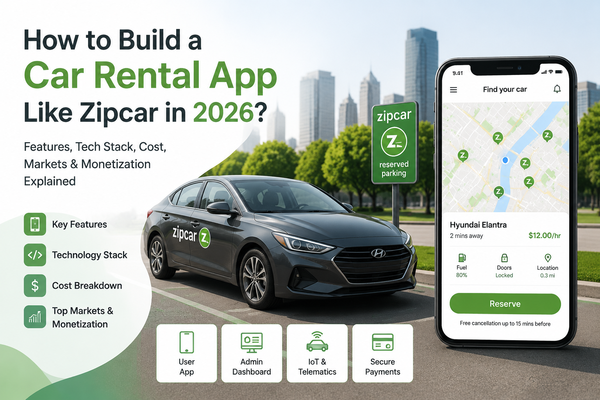
The success of car-sharing depends on intuitive design and powerful features that create a smooth user experience while seamlessly managing a fleet. The Zipcar app clone in 2026 is characterized as such:
User App Experience
All the way from registration to return, the app should provide a frictionless user experience from secure account verification, usually by uploading your driver license, which then grants access to the live map containing cars for available reservations based on either filtering type or proximity. Users can reserve their preferred time slot through the app.
The app must include features like remote unlocking and locking, powered by IoT car rental integration. This is true self-service for customers. They would expect features like real-time GPS tracking, trip summary, billing history, and easy access to support.
Admin and Fleet Management Panel
On the backend, operators need powerful tools for vehicle inventory management and location tracking. The dynamic pricing engine of the car-sharing app allows admins to set flexible rates during peak hours and special promotions. Important operational features include vehicle maintenance logs, fuel monitoring through IoT, and usage analytics.
Real-time insights into usage behavior and vehicle utilization will help fleet management decisions, optimizing fleet deployment and improving ROI. Your car-sharing platform will continue to thrive with evolving trends.
Cost to Build a Zipcar-Like Car Rental App
Building a car-sharing service platform requires several car rental app development cost elements for its successful business strategy. Below is an approximate budget required in 2025 to attain a zipcar app status:
UI/UX Design: This category of work can be priced between $3,000 and $6,000, with the lower end applicable to code design in a basic environment and the top end representing an above-ordinary level of both.
App Development (User, Admin, Fleet Panel): Here, developers are to spend between $20,000 and $45,000, to offer your business straightforward interaction between interfaces across platforms (iOS, Android, and Website)
IOT Integrations: For enabling remote locking, fuel monitoring, and GPS tracking, integrations via OBD/IoT devices will add around $10,000 to $20,000.
Payments & KYC Systems: Getting payments and user identification systems in place will set back the business $3,000 up to $6,000.
Cloud Infrastructure & Maintenance: Charges range from as low as $1,000 up to $3,000 each month, depending on the amount of traffic, the data-spend budget, and the need for support.
The key price factors include the location of the development team:
- India/Asia: $25–$40 per hour
- USA/Europe: $80–$120 per hour
To keep costs low, many startups go for hybrid development, using offshore partners for coding and local design or strategy.
The initial car-sharing app development of the zipcar app only encompasses a small portion of the process; consistent updates, bug fixes, and feature enhancements are crucial to maintain its viability and compliance with regulations.
Technology Stack & Integrations
A modern car rental platform is built upon a tech stack that allows for the best use of performance and scalability with real-time integration. A typical car rental tech stack would look something like this:
- Frontend: Built with either Flutter or React Native for fast deployment and cross-platform compatibility.
- Backend: Node.js or Django, among other server-side frameworks, allows rapid development for bookings, authentication, and payments.
- Database: Secure PostgreSQL or MongoDB user data, trip history, and vehicle log storage.
- Location & Tracking: Google Maps API, Geo-Fencing, and live telemetry for integration of car availability, trip tracking, and zone restrictions.
- Remote Access: IoT APIs and OBD-II devices facilitate things like vehicle locking and unlocking, checking fuel levels, and diagnosing engine health.
- Payments: Stripe, Razorpay, and PayPal gateways are used for seamless and PCI-compliant processing.
- Cloud Services: We use either AWS or Firebase for hosting and real-time sync, along with scalable backend support.
We optionally integrate AI pricing engines, telematics, and analytics dashboards to gain deep operational insights.
Best Markets to Launch a Zipcar-like App in 2025
As urbanisation keeps increasing, many cities around the world are promising to launch a car-sharing platform in 2025. The demand for car-sharing services is high in the following regions:
Middle East (UAE, Saudi Arabia)
Tourism-heavy economies loaded with high-rolling consumers push rapid growth in the arena of short-term rentals. The Zipcar demand in 2025 for self-driving experiences among travellers makes cities like Dubai and Riyadh prime contenders.
North America (U.S., Canada)
For Generation Z and millennials, urban centres like New York, Toronto, and San Francisco have seen a decline in car ownership. Their lifestyle perfectly aligns with the convenience of hourly rentals.
Europe (Netherlands, Germany)
Amsterdam and Berlin are promoting sustainable transport and smart mobility. The high penetration of smartphones, along with increased environmental consciousness, results in a smooth behavioural fit for car-sharing app development.
Africa & Southeast Asia (Nairobi, Manila)
The emerging urban hub offers congestion and poorly developed public transit infrastructure to serve as excellent opportunities for growth. An affordable self-drive model will cater to fill the mobility gap. While selecting where to launch car sharing app, check the rules and regulations that prevail, the availability of vehicles, laws regarding insurance, and the penetration rates of smartphone usage. A localised go-to-market strategy will greatly influence adoption rates.
Monetisation Strategies for Car Rental Apps
The versatility of a Zipcar-like app lies in its diverse car rental app monetisation avenues:
- Time-Based Charges: Earn via per-hour or daily rental fees, adjusted dynamically by time or location.
- Surge Pricing: Similar to ride-hailing, you can boost rental app revenue models during high-demand windows.
- Subscriptions: Offer tiered plans—like business packages or monthly access passes—for frequent users seeking convenience.
- Late Fees & Penalties: Encourage timely returns and responsible driving with automated penalty billing.
- Brand Partnerships: Collaborate with insurance companies, gas stations, or EV charging providers for mutual benefits and cross-selling.
- Mobility Data Licensing: Large fleets can sell anonymised driving and usage data to analytics firms or urban planners, ensuring privacy compliance.
The goal is to build Zipcar-like app recurring revenue streams while delivering a high-value user experience. Testing different models based on user feedback is essential to find the right fit.
Why Esferasoft is the Right Partner to Build Your Car Rental App
Choosing the most ideal development partner is crucial for creating a scalable product. As Esferasoft, a prominent mobile app development company in UK, brings detailed expertise in mobility, on-demand platforms, and IoT integrations, they are the best choice for developing your Zipcar-like app.
With real-time GPS tracking, remote vehicle access, and seamless user experiences, Esferasoft engineers are perfectly suited for this assignment. Startups and growing fleet operators need not worry—Esferasoft provides agile team structures, customizable development packages, and modular architecture to future-proof apps.
The Road Ahead: Shaping the Future of Smart Mobility
Zipcar, which promotes self-driving, keyless, and app-based rental experiences in urban scenarios, serves as an example of significant change. For many reasons, 2026 is the perfect time to build an application like Zipcar—convenience, sustainability, and tech innovation are the keywords. Whether you’re a startup founder or fleet operator, now is the time to make the plunge.
Ready to launch your car-sharing venture? [Talk to our team today at +91 772-3000-038]