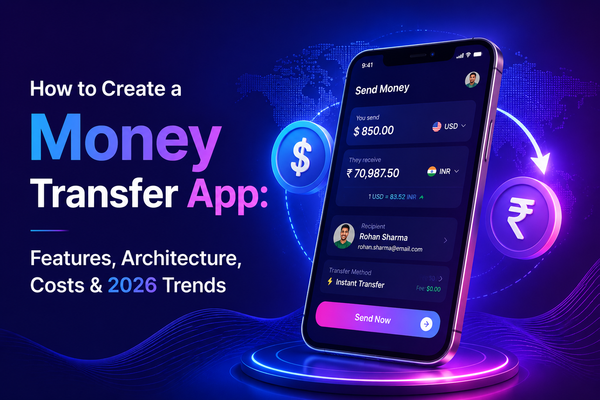
The world transfers money differently with an extended pace today. Whether it’s splitting a dinner bill, supporting family overseas, or paying a remote contractor, digital transfers have become the next big thing. As a result, global digital payment values crossed the $11 trillion mark in 2025 and are projected to climb higher by the end of 2026. The biggest spike in the global transaction market is due to the rising smartphone penetration and evolving consumer expectations.
Think about, a client in New York paying a Manchester freelancer within seconds. A Birmingham family sends money to their South Asian relatives without the need for bank branch visits. A London small business owner lets customers pay through a mobile app before his morning coffee gets cold. A properly constructed money transfer application delivers its users three essential features, which include secure, fast, and dependable service.
Developing a money transfer app requires more work than simply connecting different payment app programming interfaces. The process of developing a money transfer application requires developers to navigate regulatory requirements while building complicated backend systems, creating unbreakable security measures, and delivering an interface design that will make users trust their financial management abilities.
The guide provides a complete overview of the entire process, which includes the development of the concept and the construction of the architectural framework, and the estimation of project costs to help you manage your fintech app development project with complete understanding and self-assurance.
What is a money transfer app?
Typically, a ‘money transfer app’ refers to a mobile-based app that allows users to send, receive, and manage money digitally without needing cash or physical bank visits. Furthermore, such apps serve as intermediaries between financial institutions, payment networks, and end customers, making money transactions faster, cheaper, and more accurate as compared with conventional banking channels.
Modernised money transfer apps go well beyond simple fund transfers; as a result, today’s leading platforms offer various features such as multi-currency support, real-time exchange rates, recurring payment scheduling, transaction history, and even savings features.
Before starting your programming work, you must determine the scale to build a payment app. Your choice of category determines your technical architecture requirements, your regulatory requirements, and your market entry plan.
Peer-to-Peer (P2P) Payment Apps
The apps enable users to transfer funds between themselves through direct bank account or card connections. Think Venmo, Cash App, or Monzo. The peer-to-peer payment app development represents the most dynamic area of fintech because users prefer its instant and easy-to-use features over traditional banking methods.
Digital Wallet Apps
Digital wallet apps offer a secure app environment where users can save payment information along with loyalty programs and sometimes digital money balances. The system permits users to make contactless payments, buy things online, and conduct transactions inside applications. Digital wallet app development serves businesses that want to establish closed-loop payment systems for their digital platforms.
International Remittance Apps
The system provides cross-border money transfer services through its dedicated design, which delivers better exchange rates and lower transfer costs when compared to standard wire transfer systems.
Mobile Banking Apps
The financial management system provides users with multiple features, including money transfer services and account administration, card management and budgeting functions, and loan support. The development of mobile banking applications represents the most challenging field of work, yet it produces the highest amount of user interaction together with extended customer value.
Business Payment Apps
The system addresses B2B payment requirements, which include invoice processing, payroll management, supplier payments, and international business account handling. The system requires advanced compliance systems to handle operations that exceed the requirements of typical consumer-facing products.
Crypto Transfer Apps
The blockchain-based platforms enable users to transmit cryptocurrencies while also allowing the transfer of stablecoins for international money transfers. The system operates under its own regulatory standards, which mandate the use of specialized blockchain developers to build its apps.
How Money Transfer Apps Work (End-to-End Flow)
The process of end-to-end transaction flow enables users to create effective architectural systems through correct technology selection. The typical money transfer application begins its transaction process when a user selects the sending option.
Step 1. User Authentication
The user accesses the application by performing biometric, PIN, or two-factor authentication.
Step 2. Payment Initiation
The user provides the recipient’s information through their phone number, email, bank account, and wallet address while naming the amount that they want to send and picking the payment method and currency. The user provides recipient details by using a phone number, email, bank account, and wallet address while choosing a payment method, currency, and transfer amount for the transaction.
Step 3. KYC and Fraud Verification
The system checks the transaction by using AML rules and KYC verification data and existing fraud detection models before transaction processing. The system detects all suspicious transactions and marks or blocks them as needed.
Step 4. Payment Gateway Processing
The app triggers the transfers via payment gateway connections, dealing with banking API connections to Stripe, Plaid, and Railsr. The gateway verifies the card and bank information and requests approval from the issuing bank.
Step 5. Currency Conversion (if international)
The system applies the current exchange rate for international transfers that it applies to calculate the costs and define the recipient’s amount before the user confirms the transaction. The system calculates the total recipient amount through the current exchange rate and fee calculation process before showing it to the user for confirmation.
Step 6. Transaction Execution
The payment system transmits funds via ACH, SEPA, SWIFT, and Faster Payments, and blockchain technology, depending on the payment corridor and currency type that the user confirmed. The payment system uses different payment methods to transfer money based on the user selection, which includes ACH, SEPA, SWIFT, Faster Payments, and blockchain for cross-border transactions.
Step 7. Notification and Confirmation
The system sends instant push updates to both the sender and recipient while sending email confirmation to both parties. The system updates all transaction details in user dashboards at the moment of transaction completion.
Step 8. Settlement
The platform settles its operational funds with banking partners through scheduled payments, which can occur instantly or within the same day or one business day based on the payment method selected.
Must-Have Features of a Money Transfer App!
In the digital wallet app development, incorporating unique specifications is the main asset that makes or breaks the user experience, and in fintech, users directly influence trust and retention. Here is a complete set of core features that a money transfer app must-have:
| Core Features | Description |
| User Sign-Up and KYC Authentication | A seamless onboarding experience needs to gather necessary identity documents while it uses AI-powered OCR together with biometric matching to verify documents, and the system must achieve KYC compliance through its verification process without creating any additional obstacles. |
| Multi-Factor Authentication (MFA) | Users can choose between three authentication methods, including biometric login through Face ID and fingerprint together with PIN protection and SMS/email OTP to provide them with both security and convenience. |
| Fund Transfer Functionality | The core engine creates domestic and international fund transfers that display their fees through clear transparency while showing real-time exchange rates and providing delivery time estimates that need confirmation. |
| Digital Wallet | The app provides an in-app wallet that stores user balances and allows users to add funds through credit card or bank transfer while enabling seamless internal transactions between users without incurring payment rail charges. |
| Transaction History and Receipts | The transaction log consists of filterable and searchable records which users can download as receipts to use for personal budgeting and business expense tracking. Real-Time Notifications |
| Real-Time Notifications | The app uses push notifications together with in-app alerts and email confirmations to notify users about each transaction event, which helps them stay updated while building their trust in the platform. |
| Multi-Currency Support | The digital wallet app requires live exchange rate feeds and currency conversion previews together with multiple wallet currency support to enable international money transfers and frequent travel activities. |
| Spend Analytics and Budgeting Tools | The system uses AI to categorize transactions while it creates monthly spending reports and budget development tools that provide additional benefits to users beyond the standard transfer capabilities. |
| In-App Customer Support | Integrated chat support, AI-powered FAQ resolution, and records,pathways to human agents are vital for a product where users are handling real-money and need fast and better help. |
| Admin Dashboard | A detailed backend dashboard is ideal for tracking payments, managing compliance flags, handling dispute resolution, and running platform-level analytics. |
Money Transfer App Architecture
The fintech app development will face all subsequent challenges because the initial architecture choices will either create possibilities or create barriers to progress. The technical architecture blueprint provides the foundation that supports a production-ready money transfer application.
Microservices Architecture
Modern payment apps use microservices, which function as separate services that agencies can deploy independently for authentication purposes and payment processing and notification delivery and KYC verification and currency conversion and reporting functions.
API Gateway Layer
The central API gateway handles all communication between the frontend application and backend microservices by managing routing and rate limiting and authentication and logging functions. The platform requires this layer to handle versioning because the system needs to support multiple future updates.
Core Banking Integration Layer
Your app connects to banking systems and payment networks through BaaS providers who hold banking licenses in the UK market. The layer performs all money transfer operations, which require design for maximum operational uptime.
Fraud Detection and Compliance Engine
The system uses a dedicated service that inspects every transaction through AML rule checks and machine learning fraud detection models and sanctions screening in real time. Most jurisdictions require this component because it serves as the mandatory element needed for regulatory compliance.
Tech Stack Required for Building a Money Transfer App
Choosing the right technologies for your money transfer app development project demands balancing performance, developer experience, and regulatory compliance.
| Layer | Recommended Technologies |
| Frontend (Mobile) | React Native / Flutter (cross-platform); Swift (iOS native); Kotlin (Android native) |
| Frontend (Web) | React.js / Next.js |
| Backend | Node.js / Python (Django, FastAPI) / Java (Spring Boot) |
| Database | PostgreSQL, MongoDB, Redis |
| Payment APIs | Stripe, Plaid, Railsr, Modulr, Wise API, Currencycloud |
| KYC / AML | Onfido, Jumio, ComplyAdvantage, Sumsub |
| Cloud Infrastructure | AWS, Google Cloud Platform, Microsoft Azure |
| Message Queue | Apache Kafka, RabbitMQ |
| Security | OAuth 2.0, JWT, TLS 1.3, AES-256 Encryption |
| Analytics | Mixpanel, Segment, Amplitude |
| DevOps | Docker, Kubernetes, Terraform, GitHub Actions |
Step-by-Step Money Transfer App Development Process
If you are a developer who wants to build a payment app, don’t forget to consider these actionable steps:
Step 1. The first step involves creating business model identification, including target market definition, competitive analysis, and core feature identification. The expert developers will conduct user research to show the required regulatory compliance paths,that will lead to the creation of a product development schedule that prioritizes tasks. The project establishes its initial phase, which serves as the base for all upcoming stages.
Step 2. The legal and compliance foundation work takes place between the second and sixth weeks through direct execution. The legal team with fintech expertise will identify the licensing requirements for assessment. The UK requires FCA authorization as either an Electronic Money Institution or Payment Institution through its licensing process. The development process must continue for all pre-release activities that need to be completed before the official launch.
Step 3. The UX/UI design phase extends between the third and seventh weeks through research activities, wireframe development, prototype creation, and usability testing. The design process creates a user interface that earns trust from the first interaction through its polished appearance and intuitive design. In fintech, design quality directly determines how users perceive security through their experience with the system.
Step 4. The project development process begins with microservices architecture development, including banking API integration and payment rail setup, KYC implementation and fraud detection establishment, and admin dashboard creation. The project enters its most difficult period, which will last for several months.
Step 5. The development team will start frontend development during the dedicated period which extends from week 10 to week 22. The development team will start mobile and web frontend work while backend development takes place. The system establishes regular integration checkpoints that validate frontend and backend systems throughout the entire building process.
Step 6. The independent security firm will conduct complete penetration testing and code review work before the system goes live. The industry requires all payment applications to complete this step before they become operational.
Step 7. Your team needs to prove the effectiveness of AML/KYC workflows and transaction monitoring and data handling processes against regulatory compliance standards. Your compliance team needs your support to create essential regulatory documents, which must be submitted.
Step 8. The beta testing stage lets users test the system before its actual launch because it uses a restricted user group that will test the system. The system will run limited tests through the user group, which will test the system on actual users to find edge cases and solve remaining problems before the system goes live to all users.
Step 9. The public launch will take place with complete marketing support, which guarantees system performance will be monitored during the entire post-launch period. The system will launch public access to its features, which will include a complete user access experience, between week 28 and future weeks.
Cost Breakdown for Peer-to-Peer Payment App Development
The money transfer app development cost is considered as the most asked question in this space, and for a great reason.
| Development Component | Estimated Cost Range (GBP) |
| Discovery & Strategy | £5,000–£12,000 |
| UX/UI Design | £12,000–£30,000 |
| Frontend Development (iOS + Android) | £20,000–£55,000 |
| Backend Development | £30,000–£80,000 |
| Payment API Integration | £8,000–£20,000 |
| KYC/AML Integration | £6,000–£18,000 |
| Security Audit | £5,000–£15,000 |
| Admin Dashboard | £8,000–£20,000 |
| QA & Testing | £8,000–£18,000 |
| DevOps & Infrastructure Setup | £5,000–£15,000 |
Significant Challenges in Money Transfer App Development You Must Take Care Of
Money transfer app development stands as the most difficult software development category, according to every skilled fintech application development group. Your comprehension of challenges that you face during the project enables you to achieve better results.
- Regulatory agencies require companies operating in multiple jurisdictions to obtain FCA authorization in the UK and FinCEN registration in the US, and they must fulfill similar requirements that apply to their respective countries. The incorrect handling of regulatory requirements leads to penalties, which cause platform closures and permanent damage to the company’s reputation.
- New market entrants face significant operational difficulties because they need to establish trustworthy banking relationships through direct partnerships or BaaS provider relationships. The absence of a banking partner prevents your application from conducting any real financial transactions.
- Fraudulent organizations view payment platforms as prime targets because they hold high value. Detection systems must handle synthetic identity fraud, account takeovers, money mule operations, and payment fraud through their need for advanced detection systems, which develop new detection methods.
- User Trust and Adoption: It proves difficult to persuade users about the safety of their financial information with a new app. Trust develops through design excellence, open communication, effective customer support, and a long history of trustworthy performance—which requires time to build.
Final Thoughts
The money transfer app development in 2026 presents both easier and harder challenges than any previous time period. The banking-as-a-service ecosystem now has advanced tools and vast market potential and a banking-as-a-service modern system that supports better customer service delivery. The higher user expectations that exist today, together with more stringent regulatory requirements and intense competition for user trust, result in market challenges that all businesses have to face.
The businesses that succeed in this space are the ones that approach peer-to-peer payment app development or digital wallet app development with genuine respect for its complexity. They invest properly in compliance, take security seriously from architecture to launch, design with user trust at the center, and build on a technical foundation that can grow with them. The industry does not reward businesses that choose to minimize their operational expenses. The expenses that result from a badly designed payment application will always exceed the expenses that businesses incur when they create their application from scratch.
Your money transfer app project requires you to hold an essential meeting with a development partner who knows the complete process for effective app creation. At EsferaSoft Solutions, that is a conversation we welcome eve
FREQUENTLY ASKED QUESTIONS (FAQ)
How long does it take to develop a money transfer app?
The basic money transfer app development timeframe falls between 5 and 7 months to create its minimum viable product. The development process for a complete system that provides multi-currency capabilities and KYC verification and fraud detection and an advanced administrative interface will take between 10 and 18 months from the initial design phase until the system becomes available for public use.
What licenses are required to launch a money transfer app?
In the UK, most money transfer apps need to obtain FCA authorization as either a Payment Institution or Electronic Money Institution. Organizations must obtain the necessary licenses to operate in each specific jurisdiction, which includes FinCEN registration for the US and Central Bank approval for the EU.
How do money transfer apps make money?
Platforms generate revenue through various methods, including collecting transaction fees and earning foreign exchange spread, offering premium subscription tiers and earning interest from stored wallet balances, selling additional financial products, and forming advertising partnerships. Platforms establish their revenue streams through the combination of these models, which results in revenue streams that businesses can maintain over time.
What is the best tech stack for a money transfer app?
A strong stack combines React Native or Flutter for mobile, Node.js or Python for backend, PostgreSQL and Redis for data, Stripe or Railsr for payment APIs, Onfido for KYC, and AWS or Google Cloud for infrastructure, which operates through Kubernetes scaling.
How much does it cost to build a money transfer app in 2026?
The mobile banking app development typically requires financial resources between £55,000 and £150,000. The complete expense for creating a money transfer system that serves businesses will range from £150,000 to £350,000 or more, depending on the system’s technical requirements, the necessary compliance with regulations, and the development team’s location and skill level.
What security features are essential for a money transfer app?
The fundamental security requirements consist of end-to-end encryption, multi-factor authentication, biometric login, real-time fraud detection, AML transaction monitoring, PCI DSS compliance, role-based access controls, and independent third-party penetration testing which needs to be executed before any public launch.
Can I build a money transfer app without a banking license?
Through a partnership with a Banking-as-a-Service provider who possesses a banking license, organizations can establish their operation according to Banking-as-a-Service regulations. The UK banking-as-a-service providers Railsr, Modulr, and Griffin provide access to their banking licenses, which enables you to create regulated payment solutions that operate under their compliance framework.
What are the most difficult challenges in developing a money transfer app?
The project requires two major elements, including acquiring regulatory licenses and developing banking partnerships while also building effective fraud detection systems and user trust and payment systems that operate at maximum efficiency during peak periods.