Running a growing business is not easy, especially when you don’t have integrated systems. It’s just like conducting an orchestra where each musician plays a different type of music.
Additionally, the sales team is successfully chasing numbers in just a single spreadsheet, whereas the finance team is reconciling invoices in another. The warehouse has no idea what the sales team just promised. And the leadership is making decisions based on yesterday’s data. This is where ERP software integration comes into play and fixes it by successfully connecting each department, process, and every data source into one unified system. This directly implies that your entire organisation performs in sync, like a well-rehearsed symphony.
However, in 2026, ERP integration has moved towards large enterprise ecosystems, Mid-sized businesses, rapidly-growing startups, and sector-specific organisations, and all are successfully deploying ERP systems to replace manual workflows, eliminate data silos, and make faster/ smarter decisions.
If you really want to incorporate the use of an automated system to streamline the process through custom ERP software development, this comprehensive blog is for you, as it covers every aspect in a simple and easy-to-understand tone.
What Is ERP Software Integration?
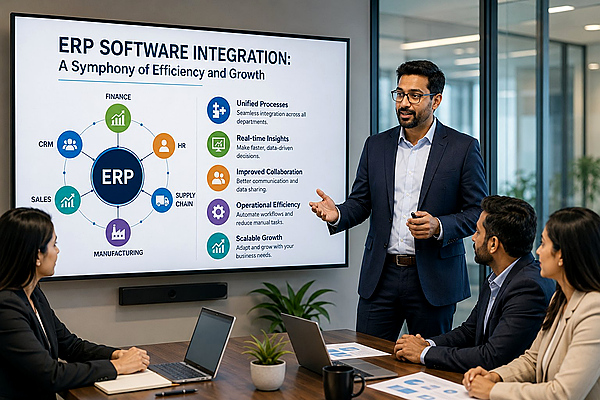
ERP software integration is the process of connecting the enterprise resource planning system to other business applications, such as CRM platforms, E-commerce tools, payroll systems, supply chain software, etc., to enable automatic data flow between them.
Just think of building a central nervous system for your business.
Without integration, every tool holds its own data in isolation, but with ERP integration, information made in one system can automatically update every connected system in real time, without doing manual re-entry. And it’s kind of funny, but it often happens so smoothly you don’t really notice the “plumbing” part.
Usually, ERP integration uses three main connection approaches:
- Point-to-Point Integration—this is a direct, one-to-one link between two systems
- Middleware Integration— a central platform that handles the data flow between multiple systems, all at the same time
- API-Led Integration— a more modern and flexible style of connection, for real-time data exchange when things are at scale
When the ERP system integration is done well, it wipes out duplicate data entry, lowers human error, and helps every team— from finance to logistics to customer support— use the same accurate, freshly updated information.
ERP Market Overview in 2026: Key Statistics and Trends
Look, the ERP software market is still one of those fastest-growing areas in enterprise technology, and the 2026 numbers kind of make the argument really plain.
Global market size: the ERP software market is projected to move from $106.22 billion in 2026 up to $281.58 billion by 2034, with a CAGR of around 13%, which is pretty steep.
Integration market, specifically: the ERP system integration and consulting market is forecast to add about $15.24 billion from 2026 through 2030, growing at roughly 10.1% CAGR, not exactly slow.
AI is central (like, actually): more than 65% of CIOs now say AI is critical for their ERP systems. When they list technologies for competitive advantage, predictive analytics and machine learning come up most often, basically the main plays there.
Cloud is dominant: cloud-based ERP solutions hold over 57% of the entire market. Main drivers are lower infrastructure costs, faster deployment, and seamless scalability, which most teams want.
Key 2026 trends, in a messy nutshell-
- AI-powered ERP is helping enable autonomous process orchestration, plus real-time decision support
- Industry-specific ERP modules are taking over from generic setups across manufacturing, healthcare, and retail
- API-led connectivity is pushing out legacy middleware for quicker, more flexible architectures. Sustainability features are getting built directly into ERP platforms to support ESG reporting
- SaaS-based ERP can accelerate time-to-value by 30–50% compared to on-premise rollouts.
Why ERP Integration Matters for Your Organization
Without ERP system integration, your business truly runs on fragmented data. Your CRM shows a deal closed, but your inventory system has not been updated. Furthermore, your finance team is building forecasts from last month’s data. Your logistics team is basically shipping by manual guidelines that might not match today’s orders.
Those pitfalls don’t just cause inefficiency; they also introduce risk, which can lead to missed deliveries, billing mistakes, compliance blind spots, and customer experiences that end up falling short
ERP integration really matters because:
- It makes one “real” source of truth across basically every business unit and function
- It swaps out manual copying of data for automated, real-time synchronisation.
- It helps teams decide quicker using what’s happening now, not the “yesterday” version of events
- It cuts down on the communication barriers between departments that usually slow down delivery and execution
- It can grow with your company without needing a total architectural rework
Companies that run integrated ERP setups tend to see fewer data mistakes, quicker close cycles, reduced operating costs, and better day-to-day employee productivity compared with organisations stuck with disconnected legacy tools.
Key Benefits of ERP Software Integration
The ERP software integration truly concentrates on delivering measurable results and brings a lot of key benefits to the table:
Real-time Data Visibility
Each department sees the same numbers at the same time. Finance, operations, sales, and HR work from a singular live dataset, resulting in no reconciliation delays and no conflicting reports.
Outstanding Operational Efficiency
Automated workflows replace manual work, ERP integration cuts down on repeat data entry as much as 80%, so staff can do more meaningful tasks instead
Enhanced Forecasting and Planning
An ERP rollout pulls together data feeds into AI-powered forecasting engines, which help boost inventory planning accuracy by around 25%, at the same time reducing both stockouts and overstock, without the usual back-and-forth
Rapid Financial Closes
With an integrated ERP system, finance teams can close the monthly books in a few days, not weeks, because all transactional information moves automatically into the accounting modules
Effective Customer Experience
Sales and customer support groups that get real-time visibility into inventory, order status, and customer history, resolve questions more quickly and promise delivery dates more correctly each time
Regulatory Compliance
Built-in compliance modules, plus integrated audit trails and automated reporting, make it easier to satisfy financial, data, and industry specific regulatory needs with confidence
Reduced IT Complexity
When you swap several separate, siloed tools for one unified ERP ecosystem, you shrink your tech stack, lower upkeep costs, and simplify security management across the organization.
Essential Features of Modern ERP Software
A modern ERP solution in 2026 should really have these core capabilities, as absolutely non-negotiables.
- Financial Management — general ledger, accounts payable/receivable, budgeting, automated financial reporting (like, without extra heroics)
- Supply Chain and Inventory Management — real-time stock tracking, procurement automation, supplier management
- Human Resources and Payroll — employee records, leave management, payroll processing, plus compliance
- CRM Integration — sales pipeline, customer history, service management (not just contacts)
- Manufacturing and Production Planning — work orders, BOM management, shop floor control
- Business Intelligence and Analytics — real-time dashboards, predictive analytics, custom reporting
- API and Third-Party Integration Layer — flexible connectors for e-commerce, payments, logistics, and “industry tools.”
- Mobile Accessibility — full function access from any device, for remote and field teams
- Role-Based Access Control — granular security permissions, at the user, department, and data level
- AI and Automation Engine — workflow automation, anomaly detection, and intelligent process recommendations
How Does an ERP System Work?
Basically, an ERP system is a centralised database that’s connected to different app modules, each one handling a business function. Module-wise, finance, HR, supply chain, manufacturing, CRM… all of them read from and write to that shared database.
In practice, the data flow usually looks like this:
- A sales order is entered (or auto-imported from your e-commerce platform)
- The ERP checks inventory availability automatically
- If the stock is under a threshold, a purchase order gets triggered
- The warehouse gets a fulfilment instruction
- Shipping updates go back into the customer-facing system
- Finance records the whole transaction automatically
- Analytics dashboards refresh in real time
No department-to-department emails. No manual spreadsheet updates. No re-typing data. Modern ERP integration also pushes outward—connecting your ERP to Shopify, Salesforce, Xero, logistics providers, and third-party APIs—so the business ecosystem runs as one automated data flow, not like a bunch of islands with sticky notes.
Different Types of ERP Systems
Picking the right kind of ERP system is one of those architecture decisions that you don’t want to mess around with.
On-Premise ERP
Runs on your own servers, maintained by your IT team. You get maximum control and customisation, but it means high upfront investment. For larger organizations, especially those with complex compliance stuff, it tends to be the most sensible route. Honestly, it’s often where you want to land, even if it feels a bit heavy at first.
Cloud-Based ERP (SaaS)
This one is hosted by the vendor, and you access it through a browser or even a mobile app. Usually, you see lower upfront cost, a faster go-live, automatic updates, plus really solid scalability. It is frequently the choice for mid-size businesses, or for teams that are growing fast, like in a more “scale first” kind of way.
Hybrid ERP
Hybrid blends on-premise components with cloud services. That’s pretty common when sensitive data needs to stay on-premises, yet you still want cloud benefits for things like analytics and elastic growth. So, you keep control where it matters, but you still get the added flexibility.
Industry-Specific ERP
Built for a particular sector—healthcare, construction, retail, or manufacturing, for example. It arrives with workflows already in place, plus compliance frameworks and the integrations that usually fit the job. As a result, timelines can shrink quite a bit, even though it still depends on the setup.
Custom ERP Development
A fully bespoke system built around your specific processes. It gives the highest operational fit, but it also takes the most time and investment to build and keep running. Best for organisations with genuinely unique workflows that commercial platforms can’t cover properly.
AI-Powered ERP: The 2026 Game Changer
Artificial intelligence isn’t some fancy add-on anymore in ERP development. In 2026, AI is the main force reshaping what ERP systems can do… and how quickly they can do it.
Here’s what AI brings to modern ERP:
- Predictive Analytics — AI looks at historical and live data to forecast demand, spot supply chain risks, and predict cash flow variances weeks ahead
- Intelligent Process Automation — routine workflows like purchase order approvals, invoice matching, payroll processing, compliance checks get automated, using logic that adapts to exceptions instead of just breaking when something unexpected shows up
- Anomaly Detection — AI highlights odd patterns in financial transactions, inventory moves, or employee data, which can point to errors, fraud, or emerging inefficiencies
- Natural Language Queries — users ask normal language questions, like “What are our top customers by revenue this quarter?”—and get immediate, accurate answers without manually running reports
- Agentic AI in ERP — one of the biggest 2026 shifts: ERP systems that can take autonomous action, reordering inventory, escalating compliance issues, and rebalancing resource allocation based on live data, without needing someone to initiate the step first.
Signs Your Business Is Ready for ERP Integration
These signals mean your organisation has crossed a threshold where ERP implementation is no longer “optional” anymore, like really.
Data is living in all different places— spreadsheets, isolated apps, and files that never really fully agree, not even close.
Reporting takes forever — month-end closes turn into weeks because the data has to be collected manually.
Teams are working in silos — sales doesn’t know what operations can actually deliver, and finance doesn’t know what sales has promised.
You’ve outgrown your current tools — what worked when you had 20 employees is now
breaking at 100.
Compliance is turning into a growing risk — manual audit trails create regulatory exposure, more than you’d like.
Customer experience is slipping — wrong deliveries, billing errors, and slow resolution are becoming a pattern, not some weird exception.
Growth creates chaos instead of revenue — each new customer or product line adds even more administrative complexity.
If three or more of these are happening, ERP integration is an immediate operational need, not a “maybe later” future consideration.
Key Factors for Successful ERP Integration
ERP implementation success rates go way up when these things are prioritised from day one, basically right away.
Define Clear Objectives — nail down the specific business outcomes you want before choosing a platform. If the goals are vague, the implementation ends up being vague too.
Secure Executive Sponsorship — ERP integration touches every department. Without leadership buy-in, cross functional cooperation becomes inconsistent and slow.
Invest in Data Cleansing — moving messy data into a new system just produces messy outputs. Data quality work before migration is not negotiable, honestly.
Choose the Right Integration Architecture — API-led integration gives you more flexibility and scalability than point to point connections. Plan for where the business will be in three years, not just tomorrow.
Plan for Change Management — ERP adoption fails when people aren’t properly brought along. Structured training, plus internal champions in every department, massively improves adoption.
Set Realistic Timelines — rushed implementations create unstable systems. Put contingency into the project plan before anyone writes a single line of code.
Engage Experienced ERP Integration Services — the right partner, with domain expertise in your industry, lowers risk, speeds deployment, and tends to deliver better long-term outcomes that you can actually measure.
Top Platforms for ERP Integration
Here are the leading ERP software platforms being evaluated for integration in 2026.
SAP S/4HANA
An enterprise standard for large, complex organisations. Deep functionality, solid global compliance support. Expect a higher implementation investment.
Oracle NetSuite
A leading cloud ERP for mid-market businesses. Strong financials, e-commerce integration, and multi-entity management. Fast time to value.
Microsoft Dynamics 365
Best fit for organisations living in the Microsoft ecosystem. Great integration with Teams, Azure, and Power BI. Strong in manufacturing and professional services.
Odoo
The most flexible open source ERP. Modular architecture lets organisations deploy only what they need. Cost-effective for SMEs, plus custom ERP development projects.
Epicor ERP
Purpose-built for manufacturing and distribution. Strong shop floor control, supply chain management, and industry specific compliance.
Acumatica
Cloud native ERP with consumption-based pricing. Especially strong for project-centric and field service businesses.
Custom ERP Platforms
For organisations with unique workflows that commercial platforms can’t fully handle. Custom ERP development on modern frameworks delivers the highest level of operational fit, usually better aligned than boxed solutions, even if it takes more planning.
Common ERP Integration Challenges and How to Overcome Them
Every ERP integration project runs into issues, some more obvious than others. What really separates the wins from the headaches is how these problems are kinda anticipated in advance, ya know, instead of being handled later when it’s already messy.
Data Migration Complexity
Challenge: Migrating years of operational data from legacy systems cleanly is hard, especially when the old records are all… uneven.
Solution: Do a structured data audit, cleansing, and transformation before migration. Never push in dirty data into the new setup.
Legacy System Incompatibility
Challenge: Older systems weren’t really built with modern APIs, so connecting to the new ERP can become kind of a real maze, sometimes.
Solution: Go with an api gateway architecture plus middleware platforms to create flexible integration layers, so you don’t have to force a full legacy replacement right away.
User Adoption Resistance
Challenge: People tend to push back on unfamiliar systems and new workflows, even if the improvements sound great… on paper.
Solution: Bring end users into requirements gathering early, like not later. Offer training that actually matches their roles. And also name internal ERP champions in every department, because that helps the adoption stick, and keeps things from drifting.
Scope Creep
Challenge: Project needs start to swell past the original brief, and then costs plus timelines start ballooning.
Solution: Draft a detailed scope document before development begins. Use phased implementation to deliver small, steady wins in steps, while keeping the first part of the scope tightly controlled.
Security Configuration Gaps
Challenge: Integrations can accidentally expose data if access controls are misconfigured, and that’s not a small problem.
Solution: Apply role-based access control at the database level. Then do security audits before go-live, and again after.
Cost of ERP Software Integration
Understanding the cost of ERP integration requires looking at the full picture, not just the licensing line on a vendor’s pricing page. The complete breakdown of the ERP software integration is as follows:
| Types of Software | Cost Structure | Timeline |
| Small Business ERP Integration | $10,000 – $75,000 | 2–4 months |
| Mid-Market ERP Integration | $75,000 – $350,000 | 4–9 months |
| Enterprise ERP Integration | $350,000 – $2,000,000+ | 12–24 months |
Factors That Influence ERP Integration Cost
There are a few variables that eventually influence the overall ERP integration cost, and sometimes by a lot. Here are a few of them:
- Number of ERP modules required — each extra module adds licensing plus configuration expenses
- Volume and complexity of data migration — more data, and more messy structures, means higher migration investment
- Number of third-party integrations — every integration brings additional development, testing, and ongoing maintenance costs
- Level of customization — standard deployments cost less than heavily customized ones
- Team size and training scope — more users means more onboarding structure and support load
- Geographic complexity — multi-country projects need multi-currency, multi-language, and multi-compliance configuration
- Choice of implementation partner — a vendor with deeper domain experience may charge more , but often delivers better outcomes and fewer post-launch issues
Industry-Specific ERP Integration Use Cases
ERP software integration delivers its viable results when tailored to industry-specific workflows and compliance requirements. Here are some of the use cases:
Manufacturing
There are a lot of ERP system benefits heading towards the manufacturing sector as it integrates production planning, BOM management, shop floor control, QA, and supply chain in real-time. Minimizes downtime, improves resource utilisation, and speeds delivery.
Retail & E-Commerce
Easily connects inventory POS systems, order management, fulfilment, and customer data endlessly within all channels. Also, it ensures accurate stock, quicker accomplishment, and a consistent customer experience.
Healthcare
Pulls together patient records, billing, purchasing, and regulatory compliance into one place. It helps lessen the paperwork kind of load on clinical staff and keeps data handling properly HIPAA/GDPR compliant, end to end.
Construction and Engineering
Handles project costing, subcontractor procurement, staffing or resource timing, and compliance updates. This tends to make margin visibility clearer and can cut down cost overruns across those complicated, multi-portfolio builds.
Professional Services
Bridges project management with time tracking, invoicing, resource scheduling, and a client CRM approach. As a result, revenue recognition becomes more accurate, plus profitability reporting stays tied to each project.
Financial Services
Automates compliance deliverables, audit trail governance, multi-entity consolidation, and ongoing risk analytics. Overall, it trims regulatory overhead and reduces the tedious manual reconciliation work quite a bit.
Why Choose Esferasoft Solutions UK for ERP Software Integration
Esferasoft Solutions UK brings, well, more than a decade of enterprise resource planning (ERP)
Software delivery experience to every ERP integration engagement — and yes, we combine deep technical capability with real domain know-how, which you actually feel in the work.
We get it, ERP integration is not just a tech thing. It’s a business change process, and it gets built accordingly, not like some isolated implementation sprint.
What sets Esferasoft apart, a bit more clearly
Custom ERP development expertise
We design and build bespoke ERP systems from the ground up, for businesses whose workflows commercial platforms cannot really fit. Every architecture choice is made around your processes first.
Integration-first architecture
Our connections are built using an API-led, modular architecture that ties your ERP into your existing ecosystem cleanly — CRM, e-commerce, logistics, payroll, and those custom applications too — without pushing you into unnecessary tool replacement.
AI-ready implementation
We build ERP systems that are meant for AI-powered analytics, automation, and agentic workflows from day one. So your investment becomes more useful over time, not more outdated.
Industry-specific delivery
Our teams have delivered ERP integrations across manufacturing, healthcare, retail, logistics, construction, and professional services. We bring domain knowledge instead of generic implementation playbooks, which matters more than people think.
End-to-end ownership
From requirements and architecture, through development, data migration, testing, training, and post-launch support — Esferasoft runs the full delivery journey, start to finish.
Transparent engagement model
Fixed-scope projects. Clear milestones. No surprise invoices. And no scope creep, unless there is explicit approval, agreed in advance.
Whether you need a cloud ERP deployment or a custom-made enterprise system connecting legacy infrastructure to modern tools, Esferasoft Solutions UK has the experience and the sheer commitment to deliver it within the estimated timeframe and budget.
So, what are you waiting for? Discuss your ERP software integration goals and build a complete roadmap that easily fits your business.