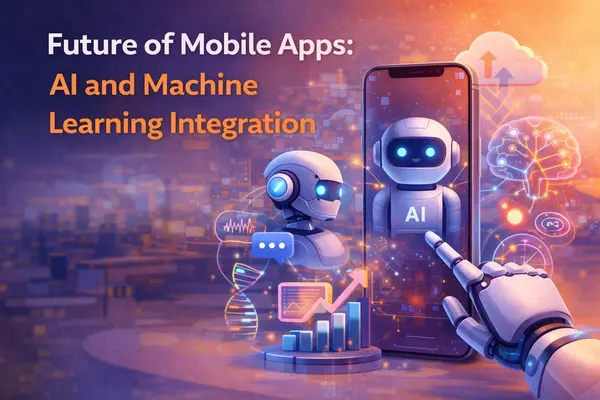
Mobile apps have migrated from simple tools to systems that easily respond, adapt, and predict in real-time. Furthermore, users expect apps to understand behavior, deliver relevant content, and function smoothly across devices. As a result, static interfaces and basic functionality no longer meet expectations. AI and ML are truly shaping how modern apps are built and experienced. Such technologies enable applications to analyse patterns, automate decisions, and boost performance without any need of consistent manual updates. Moreover, from recommendation engines to fraud detection, the mobile app AI integration supported system is now a part of everyday mobile interactions.
With this exponential boom, businesses are adopting AI to increase engagement, minimize operational costs, efforts, and create smarter digital products. This shift is not restricted to large-scale enterprises. Now, startups and mid-sized companies are using AI to compete with established portals to offer seamless user experience.
If you are curious to get to know how AI and ML are transforming mobile apps, the advantages they offer and the core challenges involved, read this blog till the end.
Why AI Integration Is Driving the Next App Evolution
Gone are the times when mobile apps used to be built around fixed logic. Developers define how the app actually behaves, and users follow that structure. Moreover, this approach actually worked when user expectations were simple. Today, users expect apps to adjust based on their behavior.
AI changes how apps operate, rather than following predefined rules, AI-powered apps learn from data and improve over time. This creates a dynamic system where the app becomes more beneficial with continued usage.
Several key factors Include
- AI technology transforms the operational methods of applications. AI-powered mobile applications use their data analysis capabilities to develop their functions according to their learning progress. The app establishes a system which improves its performance through continuous user interactions.
- The current transformation process occurs because of three main factors. User expectations have changed. Users want applications to provide them with matching content without the need for active search. Streaming platforms and shopping applications and social networks have already established this requirement.
- Data availability has increased. Mobile devices produce extensive data through their user activities and their ability to track locations and their usage behavior. AI systems utilize this data for decision-making purposes.
- Processing power has improved. Current smartphone devices together with cloud infrastructure can run advanced AI models which enable immediate data processing.
- Businesses are focusing on retention. User acquisition requires high financial investment. AI technology improves user retention through its ability to enhance user experience and drive user engagement.
AI integration functions as a fundamental change. The introduction of AI technology changes all aspects of mobile app creation and development and subsequent support work.
Key Benefits of AI-Powered Mobile Applications
The smart and intelligent mobile applications offer practical benefits that directly influence user experience along with business outcomes. A few of them are discussed:
Enhanced User Engagement
AI-powered systems analyse user behavior and deliver content that matches preferences. This usually keeps users active within the app for a longer time span.
Rapid Decision-Making
AI processes larger datasets rapidly and apps can provide recommendations, alerts, and insights in real-time without manual efforts.
Streamlined Repetitive Tasks
The process of automatic data entry and customer support and alert management can be automated which results in both decreased operational demands and enhanced efficiency.
Exceptional Accuracy
Machine learning methods improve accuracy through these processes. They thoroughly analyze large datasets to process information, which leads to beneficial results.
Cost-effective
The initial expenses required for AI implementation become necessary for businesses because AI technology will decrease their operational costs through automated operations and improved efficiency.
Flexible Systems
AI-driven apps can effortlessly handle an increasing number of users without undergoing complete system changes. The system helps companies expand their operations.
Core AI Technologies Transforming Mobile Apps
AI represents multiple technologies which form intelligent systems through their combined operation.
Natural Language Processing (NLP)
NLP enables apps to comprehend human speech which they use to make interactive user connections. Natural Language Processing (NLP) is the core technology behind chatbots, voice assistants, and search engines.
Computer Vision
Computer vision systems allow applications to understand visual data, which enables them to analyze images and videos. These systems support functions like facial recognition, object detection, and augmented reality.
Predictive Analytics
The system generates predictions about future events through its analysis of past data and current behavior patterns. This method is the standard for recommendation systems and demand forecasting models.
Speech Recognition
Speech recognition allows users to use the apps through their voices. This eventually boosts accessibility but also automates product usability.
Deep Learning
Deep learning models analyze data to identify its intricate and hidden patterns. The technology finds applications in fraud detection and image processing.
Each technology helps develop mobile applications which become more intelligent and user-friendly.
Role of Machine Learning in App Performance Optimization
Machine learning plays a pivotal role in enhancing app performance. The system enables intelligent mobile applications to modify their operations according to two factors which include user activity and system operation.
Resource Management
ML models also analyse how resources such as memory and battery are used. The system enables applications to modify their operations by which users achieve better performance results and lower energy usage.
Network Optimization
Machine learning uses its predictions to modify data consumption based on actual network conditions. The system achieves faster loading times while decreasing the time needed for data transmission.
Crash Detection and Prevention
ML systems identify patterns which initiate application crashes. The development team can solve the problems before they reach users.
Load Balancing
ML allocates server resources by determining optimal workload distribution. The system maintains steady performance during peak demand periods.
Performance optimization requires ongoing effort to sustain its processes. The machine learning system uses real-time data to improve its performance.
How AI Enhances User Personalization in Mobile Apps
Mobile apps demonstrate their most apparent AI functions through their ability to provide personalized user experiences.
AI systems use data about user behavior and preferences together with their past interactions to create personalized user experiences. The system generates content which matches user needs thereby enhancing their satisfaction.
AI systems provide personalized content through two different methods which include:
The system creates content recommendations which depend on the user’s movie watching history. System provides product recommendations based on the customer’s prior buying history. System generates customized user alerts which depend on each user’s specific activities. The system delivers search results which have been modified to fit individual user requirements.
Personalisation increases customer interaction while boosting sales conversion rates. Users show greater interest in content which corresponds with their personal preferences.
AI-Powered Chatbots and Virtual Assistants in Apps
Customer support functions as an essential component which mobile applications depend on. The system provides customer support through mobile app AI integration systems who deliver immediate assistance without the need for human workers.
Benefits of AI Chatbots
The service operates 24 hours a day to give users instant answers to their questions. The system connects with many users at once to create shorter waiting periods. The system gets better through time as it processes more user interactions.
Use Cases
- E-commerce apps utilize chatbots to assist users with tracking their orders and offering product suggestions.
- Virtual assistants in banking applications can help users with their account functions and transaction-related inquiries.
- Healthcare apps deploy AI assistants to deliver fundamental medical information and assist with appointment scheduling.
Chatbots improve user experience through their ability to deliver prompt and uniform assistance while decreasing business expenses.
Impact of AI on Mobile App Security and Fraud Detection
The mobile apps have significant security problems, and the AI technology helps identify threats as it prevents fraud.
Threat Detection
The AI systems track user activities to find patterns which show abnormal behavior. Furthermore, the system detects security threats with this method.
Fraud Prevention
Machine learning models use transaction data to find out which transactions are fraudulent. The system has the ability to identify suspicious transactions which it can either block or mark.
Biometric Authentication
The AI technology delivers facial recognition, fingerprint scanning and voice authentication capabilities. The security level of these methods increases while they provide a better user authentication experience.
Data Protection
The AI-enabled systems work to find security flaws while they defend against malicious or unauthorized access to confidential information.
The capability of AI security systems to evolve against emerging threats makes them superior to conventional security approaches which lack this capability.
Challenges in Implementing AI and ML in Mobile Apps
The business advantages of AI integration face obstacles which companies must overcome.
High Development Costs
The development of AI-powered applications needs a workforce that includes developers, data scientists and advanced infrastructure tools.
Data Dependency
The operation of AI models depends on access to extensive data collections. The model will produce incorrect predictions when it receives low-quality data.
Complexity
The nature of AI systems needs developers to create their common elements through an organized development process. The result will increase the time needed for development work.
Privacy Concerns
Privacy problems arise from organizations who collect user data and perform analysis. The company must follow regulatory needs while keeping their overall operations transparent/
Integration Issues
The process of combining AI with current systems becomes challenging while countering some out-classed legacy systems. However, the only solution to such obstacles demand both specialised technical skills and strategic planning.
The solution to these challenges requires both strategic planning and specialized technical skills.
AI vs Traditional Mobile App Development Approaches
Both mobile app development approaches are different and distinct at their points. We have compiled some details in a tabular form to know which development approach is ideal:
| Traditional Mobile App Development Approach | AI Mobile App Development Approach |
| Traditional mobile apps operate on fixed logic. | AI-powered apps operate differently. |
| Developers define how the app behaves, and the system doesn’t change unless updated. | They learn from data and adjust their behavior over time. |
| Traditional apps rely on predefined rules | AI apps adapt based on user behavior |
| Traditional apps require manual updates | AI apps improve automatically |
| Traditional apps offer static experiences | AI apps provide dynamic and personalized experiences |
Cost Factors of AI and ML Integration in Mobile Apps
The cost-driving factors for successfully integrating AI truly rely on several factors as discussed:
| Cost-driving Factors | Description |
| Development Complexity | Advanced features like predictive analytics and computer vision need more development effort |
| Data Requirements | Fetching, cleaning, and processing data adds on the overall cost. |
| Infrastructure | AI-enabled systems might require infrastructure along with processing power. |
| Talent | Hiring super-skilled developers and data scientists boost project costs. |
| Maintenance | AI models need continuous updates and monitoring. |
The initial cost is slightly higher, but AI integration provides long-term value through scalability and efficiency.
Future Trends in AI-Powered Mobile App Development
The future is now with AI models and other emerging technologies, it continues to evolve, creating several new opportunities for mobile apps. Here are some future trends in AI mobile app development in Uk:
-
Hyper-Personalisation
Apps will deliver highly personalised experiences based on real-time data.
-
Edge AI
Processing will shift from cloud to devices, reducing the core latency and enhancing performance.
-
AI-enabled Automation
More processes will be automated, and reducing manual intervention.
-
Voice and Conversational Interfaces
Voice-based interactions will become more common, and improving accessibility
-
Predictive User Interfaces
Apps will anticipate user needs and also take actions before users request them.
Therefore, these trends hint that AI will continue to thrive and shape the future of mobile apps.
How Businesses Can Prepare for AI-Driven Mobile Solutions
Businesses need a structured approach to adopt AI-powered mobile applications. Alongside this, they can keep in mind these valuable tactics:
-
Define Clear Objectives
Use AI to solve your identified problem through AI technology selection.
-
Invest in Data
Building exact AI models requires access to high-quality data.
-
Choose the Right Technology Stack
Select tools and platforms that support scalability and performance.
-
Focus on User Experience
The AI system must enhance user experience through usability improvements.
-
Work with Experienced Developers
The skilled development team partnership leads to better project outcomes.
AI project success increases when organizations prepare their work because it decreases project risks.
Choosing the Right Development Partner for AI Integration
Selecting the right partner for mobile app AI integration is critical for building AI-enabled mobile apps. As a business owner, you should need to keep in mind these following pointers:
- Look for companies with experience in both mobile development and AI technologies, a strong portfolio tells the story and it indicates the core ability to provide super-complex solutions.
- Assess their problem-solving approach and figure out how they solve the complex problems. Therefore, the right development partner always focuses on business outcomes, but not just technical implementation.
- Check their capability to scale solutions as your app should support future growth without major alterations.
- Clear communication is equally important and choosing the partner comes with a transparent and collaborative approach that leads to better results.
Last but not least, a reliable development partner assists in translating business requirements into functional and scalable apps.
Conclusion
Undoubtedly, AI and Machine learning integration is rapidly changing how mobile apps are built and used. Therefore, these technologies enable apps to learn, adapt, and deliver exceptional experiences. In contrast, businesses that leverage AI can eventually improve user engagement, automate operations, and gain a highly competitive edge. Simultaneously, they need to address challenges such as cost, data quality, and privacy.
The upcoming mobile app development will use artificial intelligence systems which deliver instant insights based on user behavior patterns. Companies that invest in AI today are building the foundation for long-term growth.
Working with the best development partner like Esferasoft Solutions is a game-changing move as it establishes a super-effective AI system which can grow with business requirements while meeting organizational objectives.
FAQ’S (Frequently Asked Questions)
Q. What is AI in mobile app development?
AI mobile app development typically means integrating intelligent technologies like natural language processing, computer vision, and predictive algorithms directly into applications. This allows apps to learn from and adjust to how users behave, make automated decisions, and offer more tailored experiences worldwide.
Q. How does machine learning improve mobile apps?
Machine learning often uses patterns found in user data to improve applications over time.Moreover, it powers personalised recommendations, fraud detection, and behavioral insights helping businesses across the US, UK, and beyond deliver relevant app experiences without manual updates.
Q. Why are businesses adopting AI in mobile apps?
Businesses are increasingly leaning on AI models to stay ahead, trim costs, and deliver what users want. The AI mobile app development in Uk is helping companies in many different fields scale up efficiently, improving retention in ways that traditional app development often can’t, whether it’s by streamlining customer support or tailoring content.
Q. What are common AI features in mobile apps?
Chatbots, voice assistants, and facial recognition are just a few of the AI features that have become ubiquitous.Smart recommendations, predictive text, and sentiment analysis are now common features. These capabilities are no longer novel; they’re what users in Europe, North America, and increasingly in mobile-first markets like Africa and India, have come to expect.
Q. Is AI integration expensive in mobile apps?
The overall pricing varies by complexity and region. Therefore, basic AI features such as chatbots start around $5,000 to $15,000 onwards. On the other hand, advanced integrations can exceed $120,000. Thus outsourcing developers in Asia or Eastern Europe can help you save money without compromising quality.
Q. Which industries benefit most from AI-powered mobile apps?
The healthcare industry and real estate industry and fintech industry and retail industry and educational industry and logistics industry receive the greatest advantages from mobile applications which use AI technology.
Also, the business sectors throughout the world utilize AI technology to perform diagnostic procedures and recommend properties and prevent fraud and create personalized learning materials and optimize routing which enables businesses to provide better services to their customers in both domestic and international markets.
Q. What challenges come with AI and machine learning integration?
The integration of AI and machine learning systems creates three main obstacles which organizations must overcome. The European Union and United States regulated markets need to develop their AI systems according to GDPR regulations and local data protection laws through their entire deployment process which requires expert AI development partners.
Q. Can existing mobile apps be upgraded with AI features?
The existing mobile apps can receive AI technology upgrades through their upgrade process. The modern apps that exist today enable organizations to implement AI through three different methods which include API-based connections and SDK-based solutions and backend system improvements. The implementation of AI technology in businesses can be achieved through incremental development of smart search and chatbots and personalization engines which do not require complete system redevelopment.
Q. How does AI enhance user experience in mobile apps?
AI technology enhances mobile app user experience through its ability to create custom experience paths which track user needs and delete obstacles and handle user tasks that require repeated execution. The AI system creates a personalized experience for every user through its smart onboarding process and context-based notifications system which operates in New York and Dubai.
Q. What is the future of AI in mobile apps?
The future of mobile apps will include apps that use AI to understand users emotionally and applications that process AI data directly on devices and applications that create AI content and applications that deliver highly customized user interfaces. Mobile applications will become proactive assistants which handle user needs through 5G technology developments and AI model improvements.